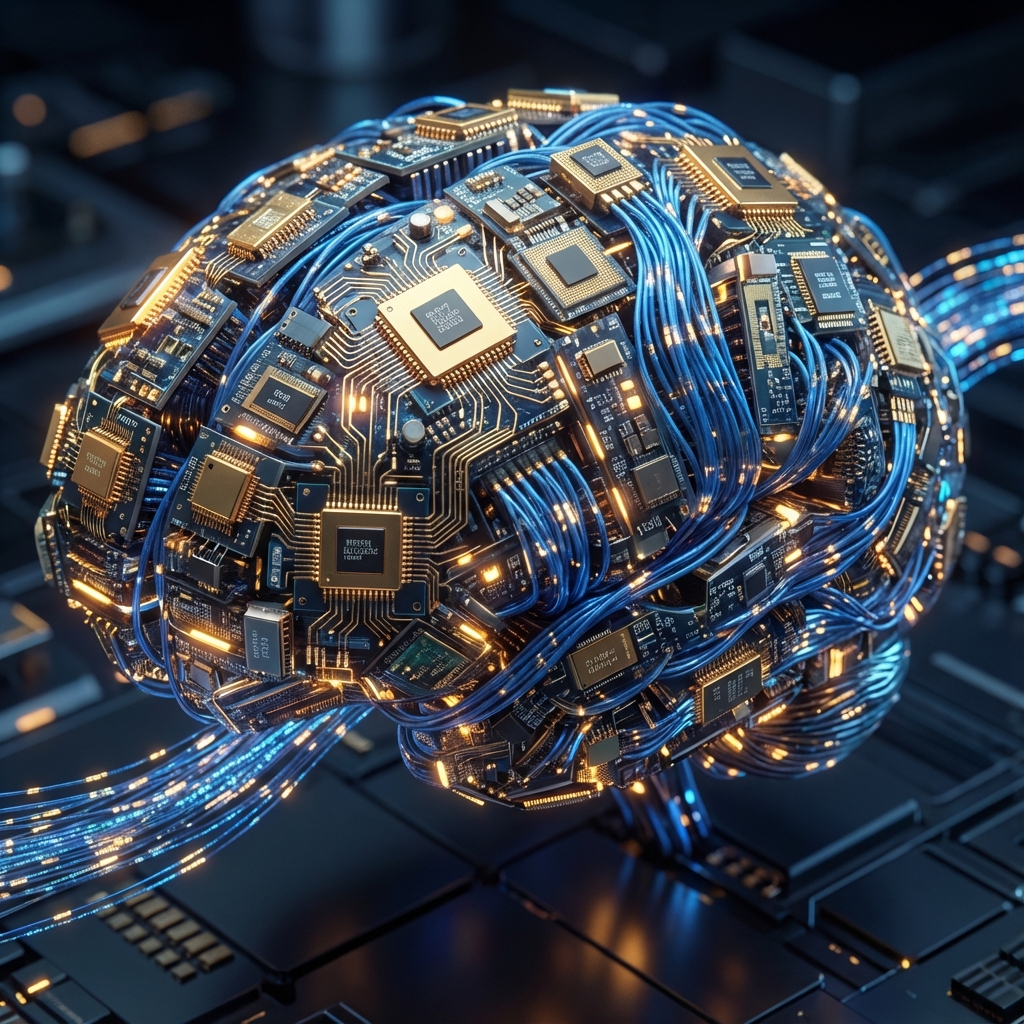
Cognitive Architecture: The Blueprint for Artificial General Intelligence
LLMs are powerful, but they are not brains. To move from text generation to true thinking machines, we need Cognitive Architectures.
In short: A Cognitive Architecture is the structural design of an artificial mind. It integrates memory, perception, and reasoning into a cohesive system that can learn and adapt over time.
What is a Cognitive Architecture?
To understand cognitive architectures, we can look at the biology of the human brain. The brain is not a single homogeneous blob of neurons; it is a collection of specialized modules.
- The Hippocampus: Handles memory storage and retrieval.
- The Prefrontal Cortex: Handles planning, decision making, and impulse control.
- The Sensory Cortex: Processes raw input from the eyes and ears.
- The Motor Cortex: Translates thought into action.
A Cognitive Architecture attempts to replicate this modular design in software. The LLM acts as the "Language Center" (Broca's area), but it needs to be connected to other software modules to function as a complete mind.
The Problem with "Naked" LLMs
A standalone LLM (like raw GPT-4) has severe limitations:
- Amnesia: It forgets everything as soon as the context window closes.
- Hallucination: It prioritizes fluency over factuality.
- Paralysis: It cannot take action in the real world.
Cognitive Architectures solve these problems by wrapping the LLM in a system that provides memory, grounding, and tools.
The Components of an Artificial Mind
In our research at Nexa-Sphere, we largely follow a modified version of the Soar architecture, modernized for the deep learning era.
1. Perception Module
This is the "eyes and ears" of the agent. It processes multi-modal inputs.
- Text: User prompts, documents, emails.
- Vision: Screenshots, images, video feeds.
- Audio: Voice commands, ambient noise. All these inputs are converted into embeddings—mathematical vector representations that the model can understand.
2. Memory Systems
Just like humans, agents need different types of memory.
Short-Term (Working) Memory
This is the context window. It holds the immediate conversation and the task at hand. It is fast but limited in size.
Long-Term (Episodic) Memory
This is the "experience" of the agent. It is implemented using Vector Databases (like Weaviate or Qdrant).
- Mechanism: When a user asks a question, the agent searches its long-term memory for "semantically similar" past experiences.
- Benefit: This allows the agent to learn from mistakes it made months ago.
Procedural Memory
This is the "muscle memory" of the agent—knowing how to do things.
- Implementation: A library of tools and Python scripts.
- Example: The agent doesn't need to "think" about how to query an API; it just calls the stored
query_api()function.
3. Reasoning Engine
The central processor. This is usually the LLM itself (e.g., GPT-4 or Claude 3.5). It takes the input from the Perception Module and the context from Memory, and decides what to do next.
Logic vs. Intuition: Neuro-Symbolic AI
The cutting edge of cognitive architecture is Neuro-Symbolic AI.
- Neural Networks (Deep Learning) are great at Intuition: Pattern recognition, fuzzy matching, creativity. This is "System 1" thinking (Fast).
- Symbolic AI (Old School) is great at Logic: Math, verifiable facts, strict rules. This is "System 2" thinking (Slow).
Combining the Two
By combining them, we get the best of both worlds.
- The Neural Network proposes a plan ("I think we should email these 3 clients").
- The Symbolic System validates the plan ("Wait, Client B has marked 'No Contact' in the database. Filter them out.").
Nexa-Sphere's Approach
We generally avoid "black box" deployments. We wrap our neural models in symbolic guardrails to ensure deterministic compliance with business rules.
The Cognitive Loop: How Thinking Happens
The process of "thinking" is a loop, not a straight line.
- Input: User says "Analyze this spreadsheet."
- Recall: Agent checks memory: "How did I analyze spreadsheets in the past?"
- Plan: Agent creates a 5-step plan.
- Execute: Agent runs Step 1 (Load CSV).
- Perceive Output: Agent sees an error: "Encoding Format Incorrect."
- Reflect: Agent thinks "I need to try 'utf-8' encoding."
- Retry: Agent re-runs Step 1.
- Success: Agent moves to Step 2.
This "Reflect -> Retry" loop is what makes agents robust.
The Future: Continuous Learning
The holy grail is Continuous Learning. Currently, most models are "frozen" after training. We are developing architectures where the agent updates its own weights (or at least its vector memory prompts) every night, meaning it gets smarter every single day it works for you.
Conclusion
The future of AI is not just bigger models; it's better architectures. As we move toward AGI (Artificial General Intelligence), the software structure that holds the model becomes just as important as the model itself.
At Nexa-Sphere, we are not just efficient coders; we are architects of digital cognition.