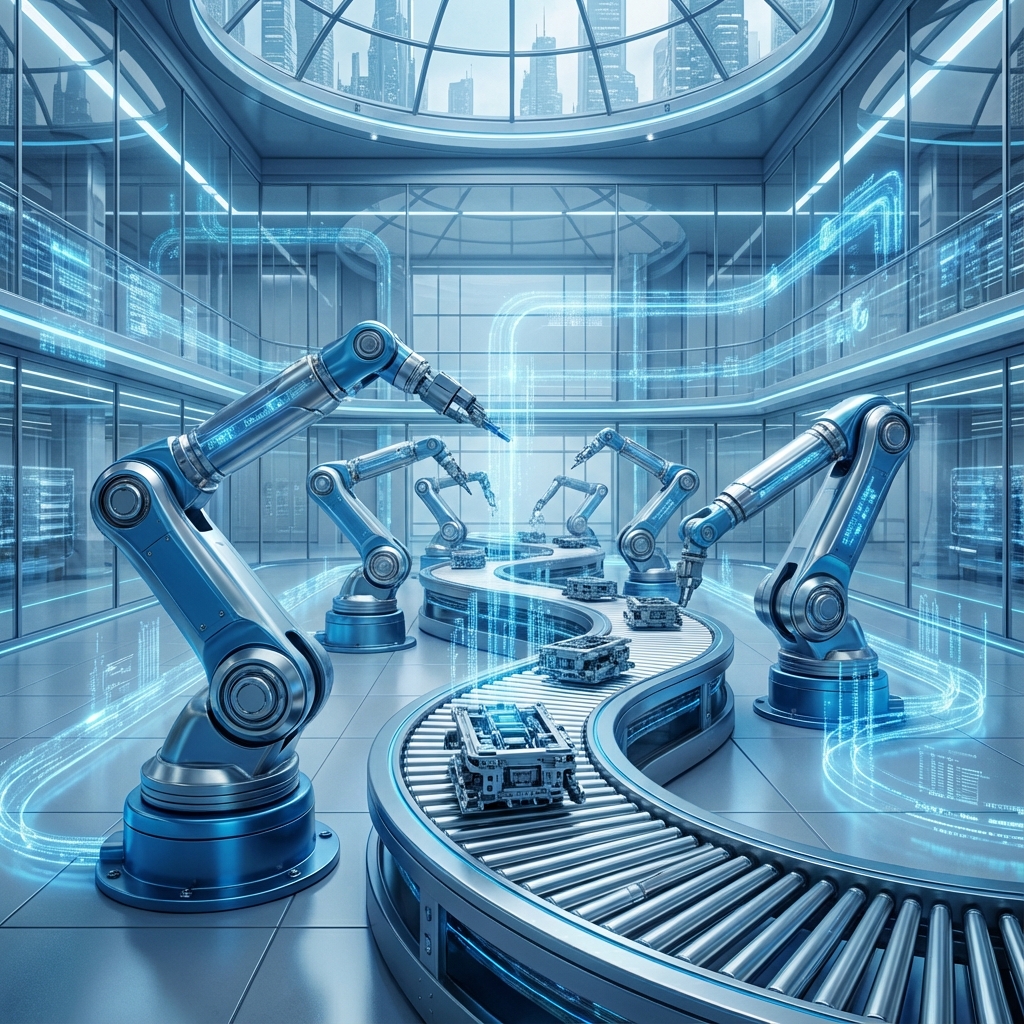
The Future of Industrial Automation: Industry 4.0 & Beyond
The factory of the past was rigid. The factory of the future is adaptive. Industry 4.0 is the convergence of physical production with digital intelligence, creating manufacturing systems that optimize themselves in real-time.
In short: It's not just about robots; it's about connected intelligence.
The Evolution of Manufacturing
To understand the future, we must look at the four industrial revolutions.
- Industry 1.0 (1784): Mechanization, steam power, weaving looms.
- Industry 2.0 (1870): Mass production, assembly lines, electrical energy.
- Industry 3.0 (1969): Automation, computers, electronics.
- Industry 4.0 (Today): Cyber-Physical Systems, IoT, Networks.
We are now moving into Industry 5.0, which brings the human element back into the loop via collaboration tailored to human needs.
The Smart Factory Ecosystem
Modern automation relies on the Industrial Internet of Things (IIoT). Every sensor, machine, and product talks to the cloud.
Adaptive Manufacturing
Traditional assembly lines are linear. A breakdown at Station 3 halts the entire line. Smart lines are modular. If Machine A breaks, the system automatically reroutes production to Machine B. The "product" carries its own routing information on an RFID tag, telling the machines what to do to it.
Digital Twins
We create perfectly synchronized virtual replicas of physical factories.
- Simulation: Operators can test "what-if" scenarios (e.g., "What if we increase conveyor speed by 15%?").
- Validation: We can catch collisions or bottlenecks in the simulation before a single bolt is tightened in the real world.
Predictive Maintenance 2.0
Downtime is the enemy of profit. In the automotive industry, a single minute of downtime can cost $22,000. Traditional maintenance is reactive ("fix it when calls break") or preventative ("replace it every 6 months").
AI-driven Predictive Maintenance is proactive.
The Physics of Failure
In our work with manufacturing clients, we use AI to analyze high-frequency data:
- Vibration Analysis: Detecting sub-millimeter oscillations that indicate a bearing is start to fail.
- Acoustic Emissions: Listening for the "screech" of unlubricated metal before the human ear can hear it.
- Thermal Imaging: Spotting hotspots in electrical panels.
By detecting these precursors, parts can be replaced during scheduled breaks (lunch, shift change), eliminating unplanned outages.
Cobots: The Human-Machine Team
The "fully automated" factory (Lights Out Manufacturing) is often a myth, or feasible only for very specific high-volume products. The reality for most high-mix, low-volume producers is Collaborative Robots (Cobots).
Safety First
Traditional robots are dangerous industrial monsters kept in cages. Cobots use torque sensors to detect human presence. If they bump into a human, they stop instantly.
Empowerment
They handle the "3 Ds":
- Dull: Repetitive pick-and-place tasks.
- Dirty: Painting, welding, handling hazardous chemicals.
- Dangerous: Heavy lifting.
This trees human workers to focus on quality assurance, creative problem solving, and machine tending.
Edge AI vs. Cloud AI
One of the biggest debates in Industry 4.0 is where the "thinking" should happen.
The Case for the Edge
In a factory, milliseconds matter. You cannot send video data to the cloud, wait for processing, and send a stop command back. The latency is too high. We deploy Edge AI models directly on the cameras or PLCs (Programmable Logic Controllers).
- Quality Control: A camera inspects 10 parts per second. The AI runs locally to spot defects instantly.
The Case for the Cloud
The cloud is used for aggregated learning. Data from 50 factories is sent to the cloud to train a master model, which is then pushed back down to the edge edges.
Workforce Transformation
The biggest hurdle is not technology; it's people. The role of the "Operator" is vanishing. The role of the "Technician" is rising.
- Reskilling: Workers need to learn how to interact with digital dashboards, not just wrenches.
- Augmented Reality (AR): We are equipping technicians with AR glasses that overlay repair instructions directly onto the machine they are fixing.
Conclusion
The factories of 2026 will not be dark, silent places run by machines. They will be vibrant, data-rich environments where humans and AI work in a choreographed dance of efficiency.
At Nexa-Sphere, we bridge the gap. We help you unlock hidden capacity in your existing assets without a complete overhaul.