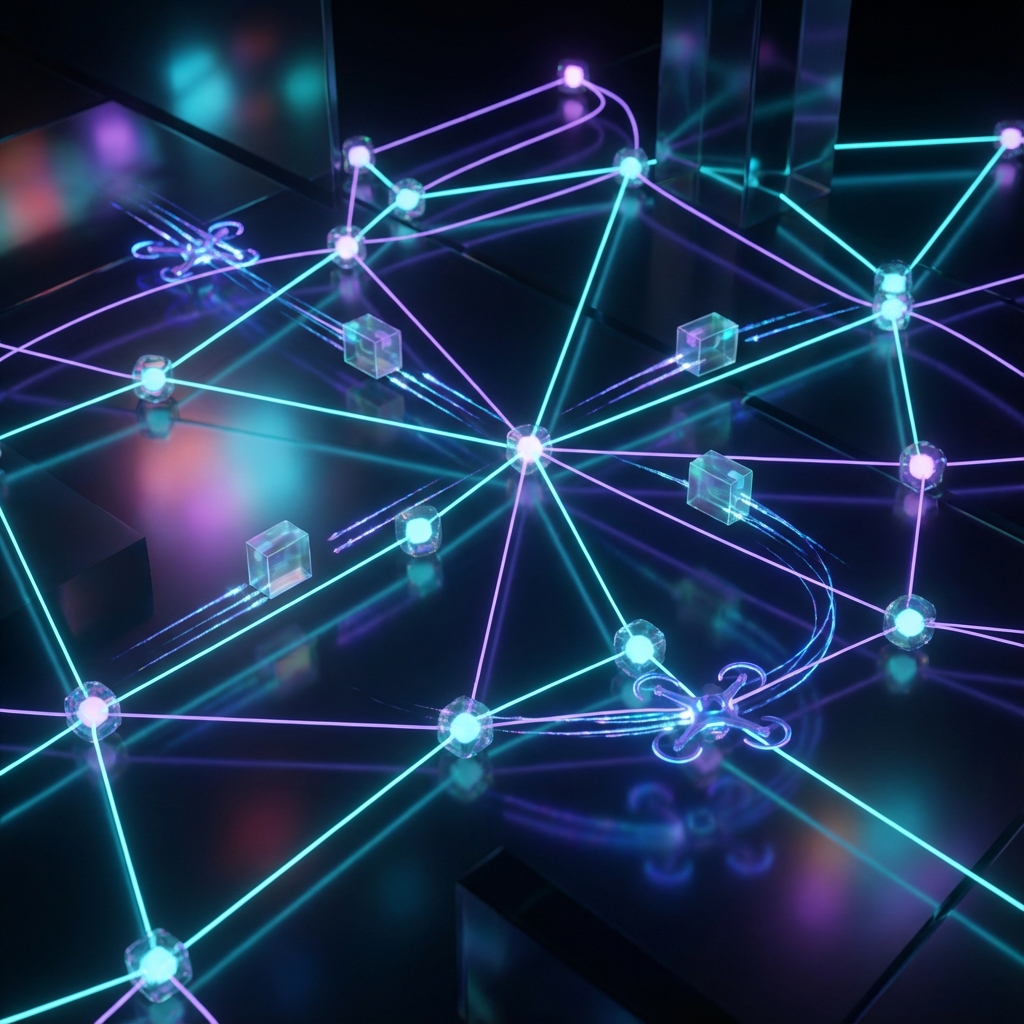
The Revolution of AI Agents: From Passive Tools to Proactive Partners
AI Agents are the next evolution of software. They are not just chatbots that answer questions; they are autonomous systems that plan, execute, and learn to achieve goals.
In short: The revolution is the shift from "using" software to "managing" digital workers. For businesses in 2026, this means moving from static automation to dynamic, decision-making intelligence.
The Evolution of Intelligent Systems
To understand where we are going, we must understand where we have been. The history of human-computer interaction is defined by a gradual reduction in friction.
From CLI to GUI to NUI
In the beginning, there was the Command Line Interface (CLI). It was powerful but required users to speak the machine's language perfectly. If you missed a semicolon, the system failed.
Then came the Graphical User Interface (GUI). We replaced syntax with symbols. Clicking an icon is easier than typing a command, but it still requires the user to know which icon to click and in what order.
Now, we are entering the era of the Natural User Interface (NUI), powered by Large Language Models (LLMs). We no longer click buttons; we state intent. "Book me a flight" replaces the 15 clicks required to search, filter, and purchase.
The Rise of the LLM
The release of GPT-3 and subsequent models marked a turning point. For the first time, computers could understand unstructured data. They could write poetry, debug code, and summarize legal documents.
However, standard LLMs have a critical limitation: Passivity. An LLM is a oracle in a box. It only speaks when spoken to, and it cannot affect the outside world. It can write an email for you, but it cannot send it.
The Emergence of Agency
This is where Agency changes the game. An AI Agent is an LLM wrapper with access to:
- Perception: The ability to read emails, browse the web, and query databases.
- Tools: The ability to execute code, make API calls, and interact with software.
- Planning: The ability to break a high-level goal into step-by-step tasks.
What Actually IS an AI Agent?
In my experience deploying agentic systems for Fortune 500 companies, I've found that defining "Agent" is the first hurdle. It is not just a better chatbot. It is a fundamental architectural shift.
The Core Loops: Perception, Reasoning, Action
A standard chatbot loop is simple: User Input -> Model -> Output.
An agentic loop is recursive:
- Perceive: The agent observes the current state (e.g., "The user wants a monthly sales report").
- Think: The agent reasons about how to achieve this (" I need to query the SQL database, then use a plotting library to generate a chart").
- Act: The agent executes the SQL query.
- Observe: The agent looks at the result ("I got the data, but it covers the wrong date range").
- Refine: The agent corrects its own mistake ("I will re-run the query with the correct dates").
The Importance of Feedback Loops
This self-correction capability is what separates agents from scripts. A script fails when it hits an error. An agent retries with a new strategy.
Tool Use: The Hands of the AI
For an AI to be useful, it must have hands. In software terms, these "hands" are APIs.
Function Calling Explained
Modern models like GPT-4o and Claude 3.5 are trained to output structured JSON objects that trigger functions.
- User: "Get me the weather in Tokyo."
- Agent: Outputs
{ "function": "get_weather", "params": { "location": "Tokyo" } } - System: Executes the function and returns
"22°C, Cloudy". - Agent: "It is currently 22 degrees and cloudy in Tokyo."
This "Function Calling" capability allows agents to interact with any software that has an API, effectively giving them infinite extensibility.
Memory Systems: RAG and Vector DBs
A gold-fish memory makes for a poor employee. Agents achieve persistence through Retrieval Augmented Generation (RAG).
By storing past interactions, company documentation, and project context in Vector Databases (like Pinecone or Milvus), agents can recall information from months ago. This allows them to maintain long-running threads of work without losing context.
The Agentic Workflow
How does an agent actually get work done? It follows a structured workflow that mimics human cognition.
Planning Phase
Before writing a single line of code or drafting an email, a robust agent creates a plan.
- Decomposition: Breaking "Build a website" into "Write HTML", "Style with CSS", "Deploy to server".
- Dependency Mapping: Identifying that "Deploy" cannot happen until "Write HTML" is complete.
Execution Phase
The agent moves through the plan sequentially.
- Step 1: Execute task.
- Verification: Check if the output matches the expectation.
- Next Step: Proceed if successful.
Reflection Phase
This is the newest and most exciting development. Top-tier agents now include a "Reflection" step where they critique their own work.
- "Did I answer the user's question completely?"
- "Is this code efficient?"
- "Is the tone of this email appropriate?" If the answer is no, the agent iterates before showing the result to the user.
Real-World Applications
This technology is not theoretical. It is driving value today.
Customer Support
The days of "I didn't understand that, press 0 for operator" are over.
- Semantic Understanding: Agents understand intent, not just keywords.
- Actionable Support: Instead of sending a link to a "How to Refund" article, the agent processes the refund directly in the payment gateway.
Data Analysis
Business Intelligence is being democratized. You no longer need to know SQL to query your data.
- Natural Language Querying: "Show me the top 3 selling products in Q3 vs Q4."
- Automated Visualization: The agent generates a Python script to build a comparative bar chart and embeds it in the chat.
Case Study: Financial Auditing
We recently deployed an agent for a mid-sized accounting firm. Its goal was to flag expense anomalies.
- The Task: Review 5,000 expense reports for policy violations.
- The Human Way: Sampling 5% of reports due to time constraints.
- The Agent Way: Reading 100% of reports, cross-referencing receipts with credit card statements, and flagging only the 3% with discrepancies. Result: 100% audit coverage with 90% reduction in human hours.
The Future Landscape (2026-2030)
We are just at the beginning of the S-Curve.
Multi-Agent Systems (MAS)
The future is not one super-agent; it is a swarm of specialized agents. Imagine a "Marketing Swarm":
- Researcher Agent: Scours the web for trends.
- Copywriter Agent: drafts content based on trends.
- Editor Agent: Reviews content for brand voice.
- Compliance Agent: Checks for legal risks.
- Manager Agent: Coordinates the hand-offs between them.
Embodied AI
Agents will undergo "Sim2Real" transfer, moving from digital environments to physical robots. The same "Planner -> Actor -> Critic" loop that writes code will soon be folding laundry and assembling electronics.
Conclusion
The revolution of AI Agents is not about replacing humans; it is about amplifying human potential. By offloading the cognitive drudgery of planning, executing, and verifying routine tasks, we free ourselves to focus on high-level strategy and creative problem-solving.
For businesses, the question is no longer "Should we use AI?" but "How quickly can we integrate Agentic workflows?"
The tools are ready. The agents are waiting. It's time to put them to work.