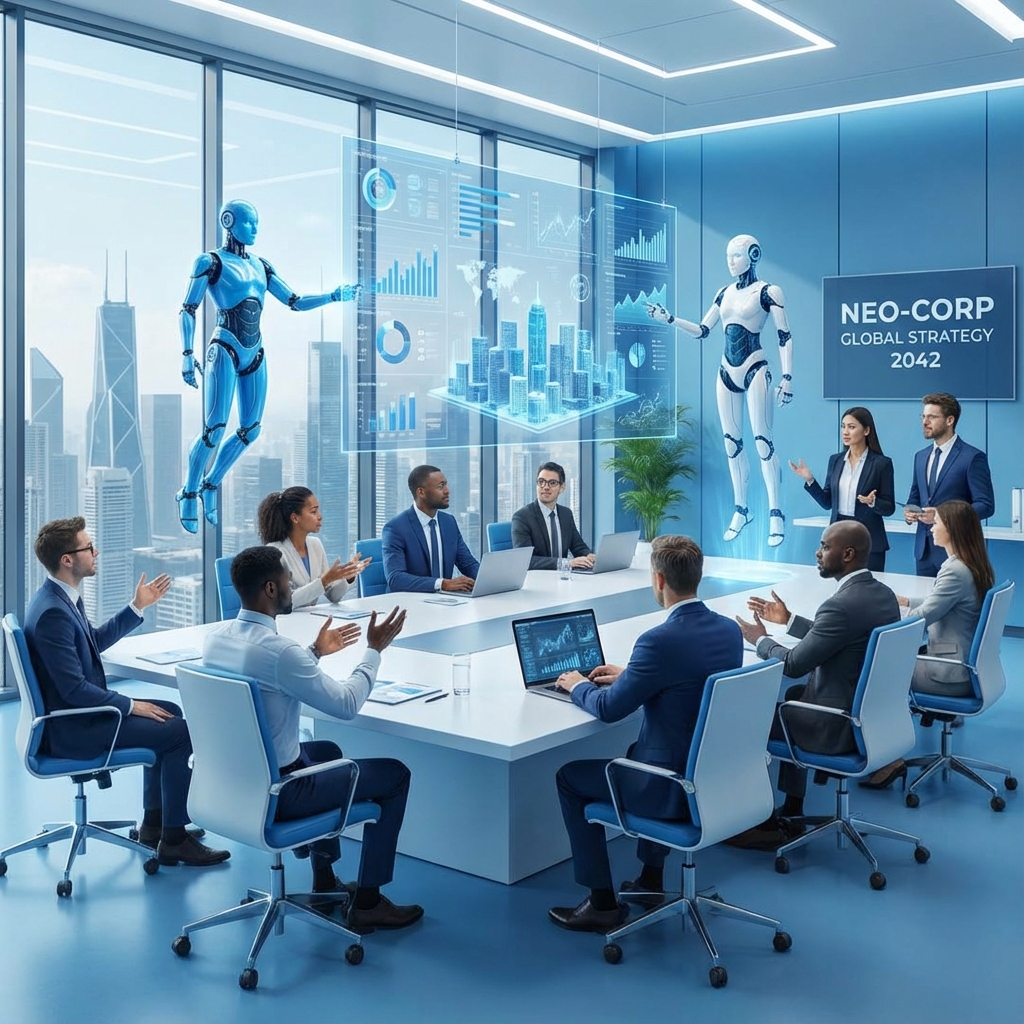
The Future of AI Agents in Business: Automating the Enterprise
Efficiency is the currency of the future. As we move past the initial hype of Generative AI, the real value for enterprise is emerging in Autonomous Business Agents.
In short: We are moving from tools that help you work to digital workers that do the work for you. This shift will redefine operational efficiency in 2026.
Beyond Automation: Intelligent Delegation
To understand the business impact, we must distinguish between traditional automation and agentic automation.
From RPA to Agentic AI
Robotic Process Automation (RPA) has been a staple of enterprise IT for a decade. It is excellent for "dumb" tasks: moving data from Spreadsheet A to Form B. However, RPA is brittle. If the form layout changes by one pixel, the bot crashes.
Agentic AI is resilient. It doesn't follow a rigid script; it follows a goal. If a button moves, the agent "looks" for it, finds it, and clicks it. If a website is down, the agent waits and retries later.
Cognitive Labor vs. Physical Labor
The first industrial revolution automated physical labor (muscles). The AI revolution is automating cognitive labor (brains). We are now entering an era where tasks like data entry, scheduling, basic research, and first-line support can be delegated entirely to machines.
The ROI Framework for AI Agents
How do you justify the investment in agentic systems? The Return on Investment (ROI) comes from three primary vectors.
Calculating Velocity
Speed is a competitive advantage.
- Human Speed: A human analyst might take 4 hours to review a 100-page contract.
- Agent Speed: An AI agent can review the same contract in 30 seconds. This 400x speed increase allows businesses to react to market changes in near real-time.
Cost Reduction Analysis
While agents are not free (inference costs money), they are orders of magnitude cheaper than human hourly rates.
- Cost per Interaction: A typical customer support call costs $5-$12. An agentic interaction costs $0.10-$0.50.
Scalability Factors
Hiring humans is slow. improved infrastructure is instant.
The "Infinite Intern" Concept
Imagine you have a task that suddenly spikes in volume (e.g., Black Friday support tickets).
- Traditional method: Panic hiring temp workers, training them for weeks.
- Agentic method: Spin up 1,000 new agent instances instantly on AWS. Spin them down when the spike is over.
Key Verticals Transformed
In our recent implementations at Nexa-Sphere, we've seen transformative results across specific sectors.
Customer Experience (CX)
This is the low-hanging fruit.
- Proactive Support: Agents that monitor user logs and reach out before a ticket is filed. "I noticed your API call failed 3 times. Here is the fix."
- Hyper-Personalization: Real-time tailoring of offers based on live behavior.
Proactive vs Reactive Support
Reactive support is "fix it when it breaks." Proactive support is "fix it so it never breaks." Agents excel at the latter because they can monitor millions of signals simultaneously.
Supply Chain & Logistics
The global supply chain is a chaotic system of moving parts.
- Predictive Resourcing: Agents that monitor global news for strikes, weather events, or political instability.
- Auto-Correction: Automatically re-routing shipments to avoid delays without human intervention.
Real-World Example
A shipping agent detecting a port strike in Rotterdam and rerouting 50 containers to Antwerp, updating all manifests and customs forms automatically.
Human Resources (HR)
Finding the right talent is an information retrieval problem.
- Talent Scouting Agents: Scouring GitHub, LinkedIn, and specialized forums to find candidates who match the culture and skillset of the team.
- Onboarding: Digital mentors that guide new hires through their first 30 days, handling all the Q&A that usually distracts senior engineers.
Financial Services
- Automated Compliance: Reviewing every single transaction for money laundering (AML) indicators, rather than just sampling.
- Risk Modeling: Adjusting loan parameters in real-time based on macroeconomic news feeds.
Implementation Strategy
You cannot just "install" agents. You must incubate them.
The "Crawl, Walk, Run" Approach
- Crawl: Deploy an agent as a "Copilot" (Human in the loop). The human approves every action.
- Walk: Deploy as an "Autopilot" (Human on the loop). The agent acts, but notifies the human, who can intervene.
- Run: Deploy as an "Agent" (Human out of the loop). The agent reports back weekly on metrics.
Data Readiness Assessment
Agents are only as good as the data they can access.
- Is your data siloed?
- do you have clean APIs?
- Is your documentation up to date? If the answer is no, your agents will fail.
Governance & Guardrails
You need a "Constitution" for your AI. Hard-coded rules that it cannot break.
- "Never offer a discount > 20%."
- "Never promise a specific delivery date."
- "Never share PII (Personally Identifiable Information)."
Risks and Mitigation
Hallucinations in Business Logic
Agents can lie. They can confidently state that 2+2=5. Mitigation: Use "Grounding". Force the agent to cite its source. If it cannot find a document in your knowledge base that supports its claim, it is not allowed to speak.
Security & Data Privacy
Giving an AI tool access to your database is a risk. Mitigation: Least Privilege Access. Give the agent a read-only API key unless it absolutely needs write access. Use ephemeral environments for execution.
Conclusion
The enterprise of 2026 will not be measured by headcount, but by Agent Count. The companies that master this transition—moving from manual management to orchestration of digital workers—will operate at a velocity and efficiency that competitors simply cannot match.
At Nexa-Sphere, we help forward-thinking enterprises navigate this transition. Is your business ready for the autonomous future?